
Termite Liquid Barrier Treatment in Clifton, NJ
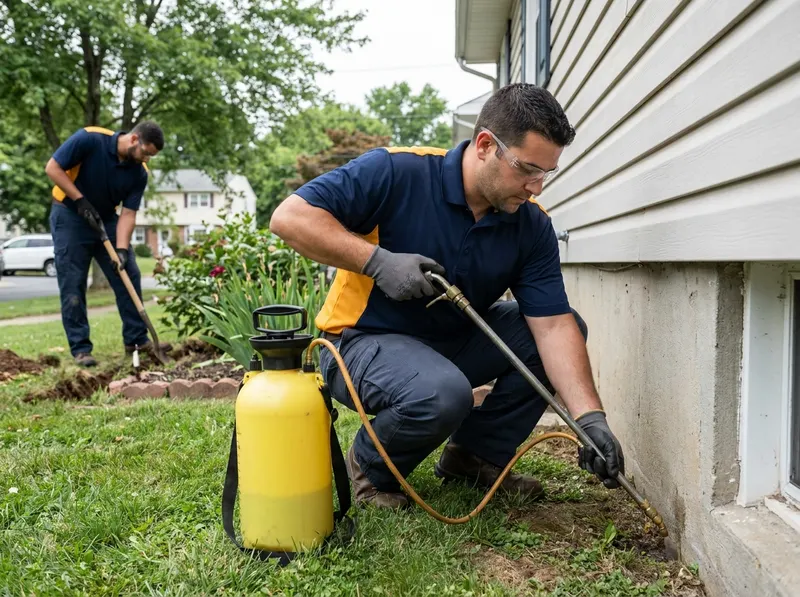
- What's included: full inspection of the foundation, basement sill area, and any crawl space; trenching around accessible foundation walls; drilling through abutting concrete such as patios, garage slabs, and stoops; termiticide applied at label rate; and a written diagram of where treatment went.
- How fast: most Clifton termite calls are scheduled within 24-48 hours, and a standard single-family liquid barrier is completed in one visit of roughly 3-6 hours depending on how much concrete has to be drilled.
- What it costs: liquid barrier work in Clifton generally runs $450-$900 for a localized spot treatment and about $1,400-$2,800 for a full perimeter on a typical single-family, with a $250 minimum service charge. These are ballparks — the exact price is confirmed after a free on-site measurement of linear footage.
- What we treat: soil against foundation walls, expansion joints, slab-on-grade additions, porch and stoop voids, garage floors, basement floor cracks, and any point where mud tubes are found entering wood.
- How to book: call (862) 429-4608 and describe what you found — mud tubes, hollow trim, discarded wings on a windowsill — and we schedule an on-site inspection with a quoted linear-foot price before any drilling starts.
Liquid barrier treatment fits the situation most Clifton homeowners actually have: an older foundation with an active infestation already inside, and a need for the problem to stop now. Termites reaching a treated soil zone die off, and the colony's route into your framing is cut. That speed is the trade-off — trenching means digging a shallow channel around accessible foundation walls, and slab drilling means small holes through concrete that get patched. <strong>A bait station system is the gentler alternative, but it works by colony elimination over months, not days.</strong> Where a homeowner in Allwood or Richfield has a finished basement, a poured patio wrapping two sides, and swarmers coming out of a baseboard in April, liquid is usually the honest recommendation. Where the perimeter is mostly inaccessible — tight zero-lot-line spacing common in parts of Botany Village and Delawanna, or hardscape that cannot be cut — a combination approach, or bait in the untreatable stretches, is the truthful answer instead of pretending a full barrier is possible.
Clifton's housing stock shapes this work more than the calendar does. The brick two-families and older frame homes across Athenia, Lakeview, and Botany Village commonly have stone or block foundations, low sill plates, and basements with a floor drain and decades of small cracks — all of which give subterranean termites a protected route up. Homes on the slopes near Garret Mountain Reservation and up through Albion Place and Dutch Hill deal with soil that stays damp against the low side of the foundation, and <strong>persistent foundation moisture is the single strongest predictor of where termite mud tubes show up first.</strong> Properties along the Weasel Brook corridor near Weasel Brook Park and Third Ward Veterans Memorial Park see the same pattern. In Montclair Heights and Rosemawr, mature trees mean old stumps, buried form boards, and landscape timbers sitting in contact with soil — steady food sources that hold a colony close to the structure. Slab-on-grade additions and attached garages, everywhere from Nash Park's side streets to newer rear extensions, get drilled because the expansion joint between slab and foundation is a direct, hidden path.
On pricing, liquid barrier is quoted by linear foot of treated foundation plus the number of concrete areas requiring drilling — not by a flat number invented over the phone. <strong>Anyone quoting an exact termite price without measuring your foundation is guessing.</strong> A narrow Clifton row-style two-family and a wide corner lot in Allwood can differ by more than double in linear footage alone. What we can commit to before arriving is the range, the method, and the fact that the on-site inspection and written quote cost nothing. <strong>There is no recurring monthly plan attached to a liquid barrier</strong> — it is one treatment, applied once, and any annual re-inspection is your choice, not a subscription you get signed into.
Before treatment we identify the pest properly. <strong>Discarded wings on windowsills, mud tubes on foundation walls, and darkened or blistered trim are termite signs; sawdust-like pellets under a hole point to carpenter ants or wood-boring beetles instead</strong>, and those need different work entirely. Clifton also has plenty of swarming ants mistaken for termites in the first warm week of spring — the difference is pinched waist and bent antennae on the ant, straight body and straight antennae on the termite. <strong>Correct identification comes first, because a liquid termiticide barrier is the wrong spend on a problem that is not termites.</strong> Call (862) 429-4608 and we will look, tell you plainly what you have, and price it in front of you. Found, sealed, and verified quiet.
Call (862) 429-4608Termite Liquid Barrier Treatment pricing in Clifton
| Minimum service charge (small localized termite work) | $250 and up |
| Spot / localized liquid treatment (single wall, stoop, or garage slab) | $450 - $900 |
| Partial perimeter barrier (one elevation or a rear addition) | $700 - $1,500 |
| Full perimeter liquid barrier, typical Clifton single-family | $1,400 - $2,800 |
| Two-family or larger footprint with slab drilling | $2,200 - $3,800 |
| Interior slab / patio drilling add-on, per concrete area | $250–$400 |
| On-site termite inspection and written linear-foot quote | No charge |
Exact price confirmed free on-site before any work.
Termite Liquid Barrier Treatment — questions, answered
How much does a termite liquid barrier treatment cost in Clifton, NJ?
Most full perimeter liquid barrier treatments on Clifton single-family homes fall in the $1,400 - $2,800 range, with localized spot treatments running $450 - $900 and a $250 minimum service charge. Price is driven by linear feet of foundation and how many concrete slabs need drilling, so the figure is a ballpark until a technician measures your property. The on-site inspection and written quote are free.
Do you have to dig up my yard and drill my basement floor in a Clifton row-style two-family?
Trenching is a shallow channel a few inches wide against the foundation, backfilled when the treatment is done, and drilling is a series of small holes through concrete that get patched. In tight-spaced Clifton two-families in Botany Village or Delawanna where a neighbor's wall or hardscape blocks part of the perimeter, we treat what is accessible and tell you honestly which stretches cannot be trenched — sometimes bait placements cover those gaps instead.
Liquid barrier or bait stations for a Clifton home with active termites?
Liquid barrier is the faster route and generally the better fit when termites are already inside the structure, which is the situation on most Clifton service calls. Bait systems eliminate a colony over months and are less invasive, making them useful where trenching is impossible or where a homeowner wants ongoing monitoring. We will explain which one your foundation actually supports before quoting.
How do I know it's termites and not carpenter ants in my Clifton house?
Termites in Clifton leave mud tubes on foundation walls, discarded wings on windowsills and near light fixtures, and hollow or blistered wood with no visible sawdust. Carpenter ants push out coarse sawdust-like shavings and have a pinched waist and bent antennae, while termites are straight-bodied with straight antennae. Identification happens at the inspection, because a liquid termiticide barrier is the wrong treatment for an ant problem.